
Rediscovering the Christian Roots, History, and Timeless Meaning of Thanksgiving
Every November, families across America gather around their tables to celebrate Thanksgiving. Homes are filled with familiar aromas, conversations bring generations together, and for a moment, the demands of everyday life are set aside. It is a beautiful tradition that reminds us to appreciate our families, our opportunities, and the blessings we have received. Yet behind this familiar celebration lies a story far deeper than the holiday itself—a story of faith, sacrifice, perseverance, and humanity's dependence upon God.
Long before Thanksgiving became an American tradition, thanksgiving was a biblical principle. Before the Pilgrims crossed the Atlantic, before the United States became a nation, and before presidents established national days of thanksgiving, Scripture had already presented gratitude as a fundamental expression of humanity's relationship with its Creator.
Understanding Thanksgiving requires us to look beyond the dinner table and rediscover both the history that shaped this tradition and the theological truths that continue to give it meaning. Its significance reaches beyond national borders, cultural customs, and historical generations. It speaks to something every human being must eventually confront: the recognition that life itself is a gift.
Before Thanksgiving Was a Holiday
The practice of giving thanks to God is woven throughout the biblical narrative. From the earliest pages of Scripture, humanity is presented as dependent upon a Creator who provides, sustains, and gives purpose to life.
In the Old Testament, thanksgiving was an intentional part of Israel's relationship with God. Leviticus 7:11–15 describes offerings presented as expressions of thanksgiving, while Deuteronomy 16:13–15 establishes the Feast of Tabernacles as a time of celebration following the harvest. These occasions were opportunities for the people of Israel to remember God's provision and acknowledge that their prosperity was not exclusively the result of their own efforts.
The Psalms capture this understanding beautifully:
“Enter his gates with thanksgiving, and his courts with praise! Give thanks to him; bless his name!”
Thanksgiving was understood as an act of worship. It was an intentional response to God's goodness and a recognition of His faithfulness throughout the experiences of life.
This principle continues throughout the New Testament. Jesus Himself demonstrated thanksgiving when He fed the multitude (John 6:11), when He prayed before raising Lazarus from the dead (John 11:41), and when He shared the Last Supper with His disciples (Luke 22:17–19). In each instance, thanksgiving directed attention toward the Father.
The Apostle Paul further established gratitude as an essential characteristic of Christian living. In 1 Thessalonians 5:18, he instructs believers to give thanks in all circumstances. This teaching places thanksgiving beyond the boundaries of a particular celebration or season. It becomes a way of understanding life through faith.
Centuries before Thanksgiving became part of American history, its deepest principles were already being taught, practiced, and passed down through generations of believers.
The Faith Behind the Journey
In 1620, a ship carrying 102 passengers departed England on a journey across the Atlantic Ocean. Known as the Mayflower, it carried men, women, and children whose lives would become part of one of the most recognizable chapters in American history.
Among its passengers were English Separatists, Christians who believed that their congregations should be independent of the established Church of England. Years earlier, members of this religious community had relocated to the Netherlands to escape religious persecution. Although they found greater religious freedom there, economic difficulties and concerns about the future of their community contributed to their eventual decision to establish a settlement in North America.
Not every passenger aboard the Mayflower shared the same religious convictions or reasons for traveling. Nevertheless, faith was central to the identity and aspirations of the Separatist community. Their journey represented a willingness to endure uncertainty for convictions they considered greater than their personal comfort.
Their religious motivations are evident in the Mayflower Compact, an agreement established in November 1620 that explicitly referenced the glory of God and the advancement of the Christian faith.
However, arriving in North America did not bring an immediate end to their hardships. The first winter proved devastating. Disease, inadequate shelter, and difficult living conditions resulted in the deaths of approximately half of the Mayflower's passengers.
Imagine entering a new year having lost nearly half of the people with whom you began your journey. Families had been separated by death, children had lost parents, and the future of an entire settlement remained uncertain.
By the autumn of 1621, the surviving settlers had experienced a successful harvest, made possible in significant part through the assistance of Indigenous people. Their circumstances had improved, although the losses they had experienced remained a painful part of their story.
This historical context gives the harvest celebration of 1621 a much deeper significance. The people who gathered that autumn understood hardship firsthand. Their celebration came after a season in which the ordinary blessings of life could no longer be taken for granted.
From a Harvest Celebration to a National Tradition
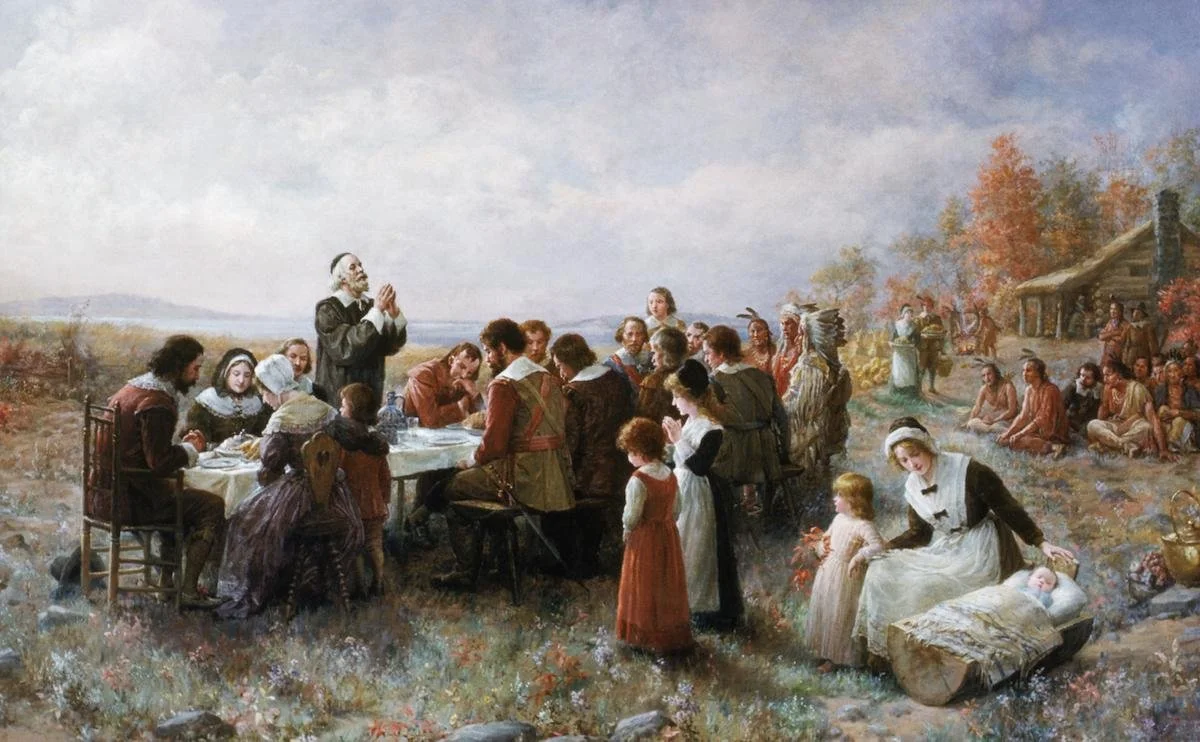
The gathering commonly remembered as the first Thanksgiving took place in Plymouth in the autumn of 1621. According to the surviving eyewitness account written by Edward Winslow, the celebration lasted three days and included the English settlers alongside Ousamequin, also known as Massasoit, and approximately ninety Wampanoag men.
Winslow's account reflects the settlers' appreciation for their improved circumstances and attributes their abundance to God's goodness.
It is important, however, to distinguish the historical gathering from the holiday Americans celebrate today. The 1621 event was a harvest celebration rather than the establishment of an annual national holiday. The settlers' formal religious days of thanksgiving were distinct occasions, often centered on prayer and worship.
The Wampanoag people also possessed their own rich traditions of gratitude and seasonal celebrations long before the arrival of European settlers. Their knowledge, cooperation, and contributions were essential to the survival of the Plymouth community, as documented by the Smithsonian's National Museum of the American Indian.
Recognizing their contributions is entirely consistent with a Christian understanding of gratitude. If we believe that God often provides through the kindness, knowledge, and generosity of others, then acknowledging those individuals is an important part of giving thanks.
Historical integrity also requires recognizing that the cooperation experienced in 1621 did not characterize every subsequent relationship between Indigenous peoples and European settlers. Later generations experienced displacement, conflict, and tremendous suffering. Some Native Americans today observe Thanksgiving as a National Day of Mourning.
Christian faith should encourage us to approach this history with both gratitude and honesty. Appreciating moments of cooperation does not require overlooking moments of injustice.
The American Thanksgiving tradition continued developing over the following centuries. On October 3, 1789, President George Washington issued a national Thanksgiving proclamation designating November 26 as a day of thanksgiving and prayer.
Washington began his proclamation by declaring:
“Whereas it is the duty of all Nations to acknowledge the providence of Almighty God.”
His proclamation encouraged Americans to recognize God's blessings, seek His protection, and give thanks for the opportunity to establish a new government. The complete historical document is preserved by the National Archives.
More than seventy years later, President Abraham Lincoln issued his own Thanksgiving proclamation on October 3, 1863, in the middle of the American Civil War.
Despite the nation's suffering and division, Lincoln invited Americans to observe the last Thursday of November as a day of thanksgiving and praise to God. His 1863 proclamation also encouraged repentance, remembrance of those who were suffering, and prayer for national healing.
In 1941, Congress formally established the fourth Thursday of November as the federal Thanksgiving holiday, securing its place in the American calendar.
Although Thanksgiving developed through different historical circumstances, expressions of faith, humility, prayer, and recognition of divine providence remain significant elements of its American heritage.
Recognizing the Giver Behind the Gift
At the heart of Christian thanksgiving is a theological concept known as divine providence. Simply understood, divine providence refers to God's ongoing care, preservation, and governance of His creation.
Christianity teaches that God did not create the universe only to abandon it. He remains sovereign over creation, sustaining life and accomplishing His purposes throughout history.
Colossians 1:16–17 teaches that all things were created through Christ and for Him, and that in Him all things hold together. James 1:17 similarly identifies God as the source of every good and perfect gift.
This understanding transforms the way Christians view their everyday lives. The ability to work, the opportunity to learn, the relationships we enjoy, the resources available to us, and even the breath in our lungs become reminders of our dependence upon God.
One of Scripture's most powerful teachings on this subject appears in Deuteronomy 8. As the Israelites prepared to enter the Promised Land, Moses warned them about the spiritual dangers that could accompany prosperity.
After experiencing abundance, building homes, and accumulating possessions, they might begin to believe that their success was entirely the result of their own strength. Moses instructed them to remember that it was God who had given them the ability to acquire wealth.
Although this passage was originally addressed to Israel within its particular covenant relationship with God, it presents a principle that remains relevant to Christians today: prosperity can become spiritually dangerous when it causes us to forget our dependence upon the Creator.
This does not diminish the importance of hard work, discipline, ambition, or personal responsibility. Scripture consistently recognizes the value of diligent labor. However, Christian gratitude places human achievement within a greater understanding of God's grace.
A person may spend years building a successful career, establishing a business, raising a family, or pursuing an education. Those accomplishments deserve recognition. Yet a grateful perspective also considers the opportunities, abilities, relationships, and circumstances that helped make those achievements possible.
Gratitude allows us to celebrate what we have accomplished without developing the illusion that we are entirely self-made.
Divine providence should not be confused with the belief that every instance of material prosperity represents God's approval or that every hardship indicates His displeasure. Nor does acknowledging God's providence in American history mean that the United States possesses the same covenant relationship with God described in the biblical history of Israel.
Rather, Christian thanksgiving invites us to recognize God's goodness while approaching our blessings with humility and responsibility.

Giving Thanks When Life Is Difficult
Perhaps the greatest test of gratitude comes when life does not unfold according to our expectations.
For some, Thanksgiving is a season of celebration. For others, it may be the first holiday without a loved one, a reminder of financial difficulties, a period of uncertainty, or a moment when the absence of something important becomes particularly painful.
The Christian understanding of thanksgiving does not require people to pretend that suffering does not exist. Faith allows room for grief, questions, disappointment, and the honest expression of pain.
The prophet Habakkuk provides a remarkable example. In Habakkuk 3:17–19, he describes circumstances in which crops fail, fields produce no food, and livestock disappear. Despite these devastating possibilities, he declares that he will rejoice in the Lord and find joy in the God of his salvation.
His confidence was rooted in the character of God rather than the predictability of his circumstances.
This helps us understand Paul's instruction to give thanks in all circumstances. There is an important distinction between giving thanks for every painful event and maintaining a heart of gratitude in the midst of that event. Christians are not required to celebrate tragedy. They are invited to trust that God's presence and faithfulness remain available even during life's most difficult experiences.
This is also what makes Lincoln's Thanksgiving proclamation historically compelling. He called the nation to give thanks at a time when the United States was experiencing profound suffering. His message recognized the nation's wounds while encouraging its people to acknowledge their remaining blessings and seek healing.
Gratitude and grief can exist within the same heart. A person can mourn what has been lost while appreciating what remains. Someone can acknowledge uncertainty about the future while remembering the faithfulness of God throughout their past.
For Christians, thanksgiving is ultimately sustained by the conviction that God's goodness is greater than the circumstances of any particular season.
The Greatest Reason for Thanksgiving
While the blessings of health, family, opportunity, and material provision are worthy of gratitude, Christianity identifies something even greater as the foundation of thanksgiving: the redemptive work of Jesus Christ.
The central message of the Christian faith is that humanity, separated from God by sin, has been offered reconciliation through the death and resurrection of Jesus Christ. Salvation is presented as a gift of grace, received through faith rather than earned through human achievement (Ephesians 2:8–9).
This understanding gives Christian thanksgiving its deepest meaning.
Even when material possessions diminish, plans change, or earthly opportunities disappear, the Christian's hope remains anchored in the promise of eternal life and reconciliation with God.
The connection between thanksgiving and redemption is also reflected in the Lord's Supper. Before giving the bread and the cup to His disciples, Jesus gave thanks. The Greek word eucharistia, from which the term Eucharist is derived, means thanksgiving.
Across Christian traditions, the celebration of the Lord's Supper serves as a remembrance of Christ's sacrifice and an opportunity to respond with gratitude for His grace.
The greatest gift Christians have received is not something that can be measured by earthly standards of wealth or success. It is the opportunity to know God, receive forgiveness, and experience the hope of eternal life through Jesus Christ.
When thanksgiving is rooted in the Gospel, gratitude becomes more than an emotional response to favorable circumstances. It becomes an enduring expression of faith.
Beyond the Dinner Table
Thanksgiving offers a valuable opportunity to bring these truths into our homes, families, churches, and communities.
Parents can use this occasion to teach their children the importance of recognizing God's provision. Families can reflect on the experiences that have shaped them, remember answered prayers, and acknowledge the people who have contributed to their lives. Individuals can extend generosity toward those experiencing difficult circumstances, recognizing that gratitude becomes especially meaningful when it inspires compassion.
The Apostle Paul connects generosity with thanksgiving in 2 Corinthians 9:11–13, explaining how the generosity of believers produces thanksgiving to God through those who receive it. Our blessings become opportunities to participate in the well-being of others.
We should also remember that thanksgiving is an invitation to reflect on the ordinary aspects of life that can easily become overlooked. A conversation with a loved one, the opportunity to begin another day, the presence of a faithful friend, or a moment of peace may appear insignificant until circumstances remind us of their value.
Developing a grateful heart means learning to recognize these blessings while they are still present.
As we gather around our tables this Thanksgiving, may we remember the historical experiences that helped shape this tradition and the biblical truths that give it enduring significance. May our celebrations create opportunities for genuine reflection, meaningful conversations, prayer, reconciliation, and generosity.
The generations that come after us should inherit more than the customs of Thanksgiving. They should inherit an understanding of why giving thanks matters, where our blessings ultimately come from, and how gratitude can shape the way we live.
The meal may end, the decorations may be put away, and the demands of everyday life may quickly return. But the faith that gives Thanksgiving its deepest meaning should remain with us throughout every season of life.
Before the feast, there was faith. And long after the feast has ended, may that faith continue to shape our hearts, our homes, and our relationship with God.
Historical References and Further Reading
Plimoth Patuxet Museums. Who Were the Pilgrims?
Plimoth Patuxet Museums. Mayflower and Mayflower Compact.
Plimoth Patuxet Museums. Eyewitness Account of the 1621 Harvest Celebration.
Plimoth Patuxet Museums. The History of Thanksgiving.
Smithsonian National Museum of the American Indian. Rethinking Thanksgiving Celebrations: Native Perspectives on Thanksgiving.
Smithsonian National Museum of the American Indian. Historical Timeline: The First Thanksgiving.
National Archives. Congress Establishes Thanksgiving.
National Archives. Thanksgiving as a Federal Holiday.
The American Presidency Project. Abraham Lincoln's Thanksgiving Proclamation of 1863.
Scripture quotation taken from the English Standard Version (ESV).
